


Your Next Enterprise UI Might Be a Conversation

How MCP can turn existing enterprise systems into reusable capabilities for AI assistants

Introduction
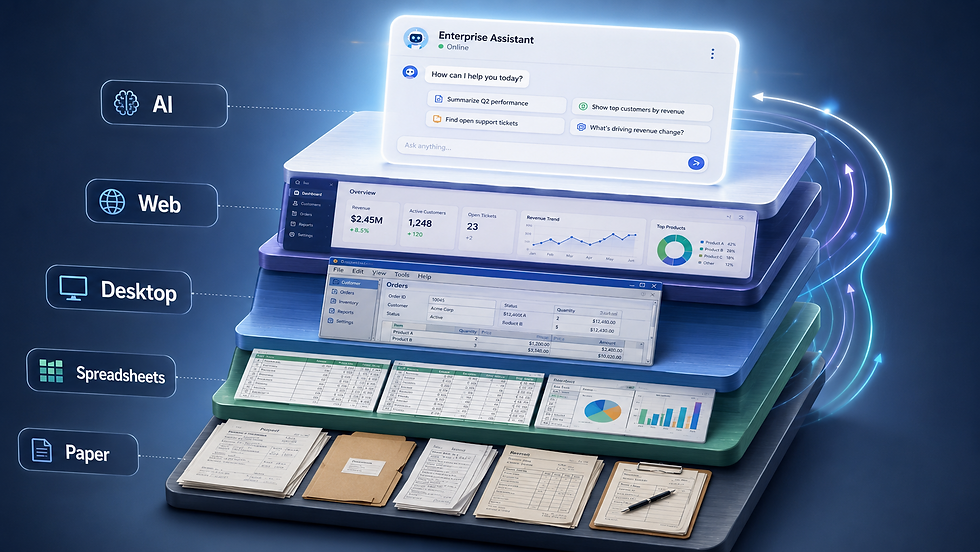
Over the last twenty five years of developing enterprise software, including deep work with public sector organisations, we have witnessed several massive shifts in how users interact with data. Paper records became spreadsheets. Spreadsheets evolved into purpose built desktop applications, which gradually gave way to web based platforms.
Each transition helped businesses manage increasing complexity, but importantly, these transitions rarely replaced what came before. Most organisations still use spreadsheets, many rely on legacy desktop apps, and paper hasn't disappeared completely. New technologies tend to stack on top of existing ones rather than replacing them outright.
Today, many companies have hit a familiar wall. They have successfully digitised their processes and built robust software platforms, but users still spend hours jumping between disconnected systems just to answer basic business questions.
This is where conversational AI and the Model Context Protocol (MCP) become incredibly interesting. Not because they replace your existing tech stack, but because they offer an entirely new way to access the capabilities those systems already provide.
The Problem We Have Today
Like many enterprises, our clients operate a massive collection of specialised systems developed over decades. One system handles licensing activities, while others manage invoicing, workflows, document storage, or public registries. Individually, these systems do their jobs perfectly well. They expose APIs, hold critical business logic, and store valuable data.
The underlying problem is that business reality naturally spans across all these systems.
A licensing officer doesn't think in terms of databases, API endpoints, or microservices. They think about applications, deadlines, blocked payments and regulatory rules. Unfortunately, those concepts are scattered across different databases. As a result, answering a seemingly simple question requires a frustrating scavenger hunt across multiple applications.
The primary challenge for modern enterprises is no longer how to store information. The challenge is how to locate, correlate and make sense of it without causing severe cognitive burden for the user. People are spending more time navigating systems than actually analysing the data they retrieve.
Why MCP Changes the Conversation
As a software engineer, your first thought might be: "Why don't we just expose our existing APIs directly to an AI assistant?" Technically, you can. However, APIs and MCP solve fundamentally different problems.
APIs are built for deterministic, machine-to-machine integration where the client knows exactly what to ask. MCP (Model Context Protocol), on the other hand, is an open standard designed specifically for AI agents that need to dynamically discover and invoke capabilities.
"MCP is therefore not a replacement for APIs. It is a standardised interface between AI assistants and your enterprise capabilities." |
A traditional app needs to handle URLs, authentication tokens, payload structures and environment specific configurations. An AI assistant shouldn't be bogged down by these implementation details. Instead, it should just interact with high level business capabilities, such as 'SearchAccount', 'GetLicence', or 'GetInvoices'.
The underlying implementation remains completely hidden. An MCP tool might call a REST API, run a SQL query, or scrape a document repository. The AI doesn't know, and frankly, it doesn't need to know. This separation is one of MCP's greatest strengths: it allows engineering teams to expose business tools cleanly while keeping the messy infrastructure details behind the scenes.

The Boundary Matters
In a serious enterprise environment, an MCP server is much more than a clever technical adapter; it is a strict control boundary. It becomes the central point where authentication, authorisation, logging, rate limiting and data filtering are applied before any AI assistant even sees the data.
This distinction is absolutely critical. A conversational UI cannot become a backdoor around your existing governance policies.
If a user doesn't have permissions to view a confidential document in the corporate repository, the AI assistant shouldn't be able to read it and summarise it for them either. If a specific business capability requires an elevated role, that rule must be enforced regardless of whether the request comes from a traditional web form or a chat prompt. MCP is valuable because it gives organisations a standardised place to govern these AI connections securely.
The Real Opportunity: Aggregation
While querying a single system is useful, enterprise software has been doing that for decades. The real game changer happens when an AI assistant can instantly aggregate information from multiple disconnected systems to deliver a single, coherent business answer.
Imagine a business user asking: "Show me all licence applications submitted this month that are currently blocked, and explain why."
Sounds simple, right? But mapping that out technically is a nightmare. One application is blocked because an invoice is unpaid (Billing System). Another is missing a PDF attachment (Document System). A third is waiting for a manager's manual review (Workflow Engine).
Traditionally, development teams would have to anticipate this exact need and build a complex custom dashboard to aggregate this data. The problem is, users never stop asking new questions. Every new question potentially requires a new integration or a new UI component.
With a conversational approach powered by MCP, developers just expose reusable building blocks. We don't have to predict every possible question in advance; the AI determines which tools to use on the fly to give the user their answer.

Starting Small: Read-Only Access
As exciting as the long term vision is, our approach right now is deliberately conservative. If you are starting out, don't let AI assistants modify data or execute critical business processes right away. Start entirely with read-only capabilities: searching, retrieving, aggregating and summarising data.
This approach dramatically reduces risk while still delivering massive immediate value. It buys your architecture team time to nail down the governance, auditing and permission models before the stakes get too high.
However, let's be clear: "read-only" does not mean "risk-free". Search and aggregation can accidentally expose sensitive correlations if access controls aren't perfectly tuned. Your implementation must respect existing user roles, maintain strict audit logs, avoid exposing unnecessary payload data and clearly cite which internal systems were used to generate an answer. Even so, starting read-only is a highly pragmatic first step to validate the user experience safely.
Not Every Interface Should Become Conversational
It’s important to stay grounded: a chat box is not the holy grail for every enterprise task. Traditional forms, dense data grids and specialised workflow screens aren't going anywhere.
If a user needs to input a well defined set of fields, approve a financial transaction, complete a highly regulated process, or monitor a real-time operational dashboard, a standard GUI is still drastically better than a conversation. The goal isn't replacement; it's augmentation.
The most useful conversational experiences will often hand users back to the right visual interface at the right moment. An AI assistant might summarise an issue in plain language, then link directly to the relevant dashboard, detail page, document, or data table so the user can inspect the underlying information properly. In that model, the conversation becomes an entry point and navigation layer, while the existing application remains the place for detailed review, structured interaction and operational control.
"The conversation does not replace the enterprise application. It becomes another layer on top of it." |
Conversational access shines when users need to cross-reference systems, investigate edge cases, or ask ad hoc questions that were never worth building a dedicated UI screen for.
Conclusion
For more than two decades, enterprise IT has evolved by stacking new layers, not by tearing down the old ones. Paper led to spreadsheets, spreadsheets to desktop apps, and desktop apps to web platforms. Each layer helped users work faster while preserving previous investments.
The Model Context Protocol represents the next logical layer in this stack. Not because it replaces enterprise systems or APIs, but because it turns them into clean, reusable capabilities that AI assistants can discover and combine under strict enterprise control.
The magic isn't just that users can talk to their software. It's that the software can finally start with a human business question, figure out which databases and documents hold the pieces of the puzzle, and bring them all together automatically. If we build systems this way, your next enterprise UI might indeed be a conversation.


